
Authorizing AI Agents on Payment Rails That Don't Forgive
Reversibility-Aware Authorization — the missing axis for irreversible agent payments, and a pattern called Progressive Commitment.


In the previous piece, Agent Governance Assumes Reversibility. Payment Systems Do Not, I argued that the hard part of agentic payments isn’t making agents smarter. It’s that on an irreversible rail, a confident mistake has no rollback.
If that’s true, then a natural follow-up question emerges: What should authorization look like when mistakes can’t be taken back?
That’s the question this piece attempts to answer.
An agent can be wrong. The cause varies —stale data, retrieval error, faulty integration, flawed reasoning — and you won’t anticipate each and every failure mode. What matters is not the cause. What matters is that the error survives long enough to reach an irreversible rail, where it stops being a recoverable mistake and becomes a permanent loss.
The pattern I want to describe doesn’t prevent those mistakes. It makes them survivable. Here are two ways the failure happens, on two different rails.
Failure 1: The Right Address on the Wrong Chain
An agent runs USDC payouts to creators, workers, and vendors. It pulls the recipient’s wallet address from its records, selects a chain, signs the transfer, and submits. All standard checks pass: amount is normal, recipient is on the allowlist, address format is valid, transaction simulates cleanly.
Yet the funds end up inaccessible to the recipient.
The agent sent to the right address on the wrong chain.
In many institutional and contract-based setups, a wallet address by itself is not sufficient identity. Exchange deposit addresses, custody contracts, Safe multisigs, and other smart-contract systems are chain-specific. A contract deployed at address X on Ethereum may not exist — or may not be controlled the same way — at X on Base.
The agent validated the address string successfully while still sending funds somewhere the recipient cannot access on that chain.
A similar failure could occur with the wrong asset representation. The recipient expects native USDC on a given network, while the agent sends a bridged variant (USDC.e being the classic example) that their infrastructure doesn’t support.
Either way, the result is a payment that is syntactically correct but operationally wrong.
This is the trap.
The agent treated “address X” (plus some chosen chain) as the recipient's full identity. In practice, stablecoin payouts often require a richer destination specification: at minimum [address X + chain Y + token Z]. Address validation alone does not guarantee the payment will reach the intended recipient in a usable form.
This risk becomes more pronounced in institutional, custody, and smart-contract-based environments (Safe multisigs, exchange deposit systems, custody platforms, etc.), where the recipient's identity often extends beyond a wallet address alone.
Basic retail wallet-to-wallet transfers are typically more forgiving, but as agentic payment volume shifts toward professional counterparties, treating an address as sufficient identity becomes increasingly risky.
How existing guardrails evaluated it:
Policy & amount limits — Pass. Focused on who and how much, not destination chain.
Address allowlist — Pass. Validated the wallet address string, not the chain where it is live.
Capability guards — Pass. Confirmed permission to send payouts, nothing about semantic correctness.
Simulation / dry-run — Pass. Checked whether the transaction will succeed, not whether success is what was intended.
Evaluation layer — No flag. The transaction is well-formed and the decision looks reasonable. It checks output shape and internal consistency, not whether the chain (or token) is correct for this recipient.
Audit trail — Logged, but too late. The payment is already irreversible.
Simulation deserves a closer look. It might work perfectly for mechanical failures (e.g., attempting a time-locked withdrawal before unlock, which I’ve seen firsthand in an earlier on-chain experiment). Even sophisticated fork-based or multi-step simulations can catch some semantic issues if they accurately replay external state.
But they have a hard limit: they validate whether a transaction succeeds, not whether success matches the intended outcome. A wrong-chain transfer or bridged token still succeeds on-chain.
Catching “Will this revert?” and “Is this the right thing?” are different problems.
The Missing Axis
Look again at that list of guardrails. Every check is asking a real question.
Policy asks: Is this allowed?
Capability guards ask: Can the agent do this?
Simulation asks: Will this transaction succeed?
Evaluation asks: Is the output well-formed?
Audit trail asks, after the fact: What happened?
None of these guardrails treats reversibility as an explicit authorization input.
In other words: if this is wrong, can we take it back?
That’s the missing axis.
Existing frameworks primarily evaluate permission, policy, and confidence. Some use informal risk tiers or human approval for high-value actions — but reversibility is rarely an explicit, first-class input in the authorization decision itself.
On final-settlement payment rails, that omission is especially costly.
I’ll call authorization that treats reversibility as a first-class input Reversibility-Aware Authorization.
On top of the usual permission, policy, limits, and confidence checks, it asks one more:
And—crucially—are the consequences of being wrong reversible, at acceptable cost and speed?
The same permission checks still apply. The difference is that reversibility becomes part of the decision itself.
That’s the framework. The behavior that implements it is Progressive Commitment.
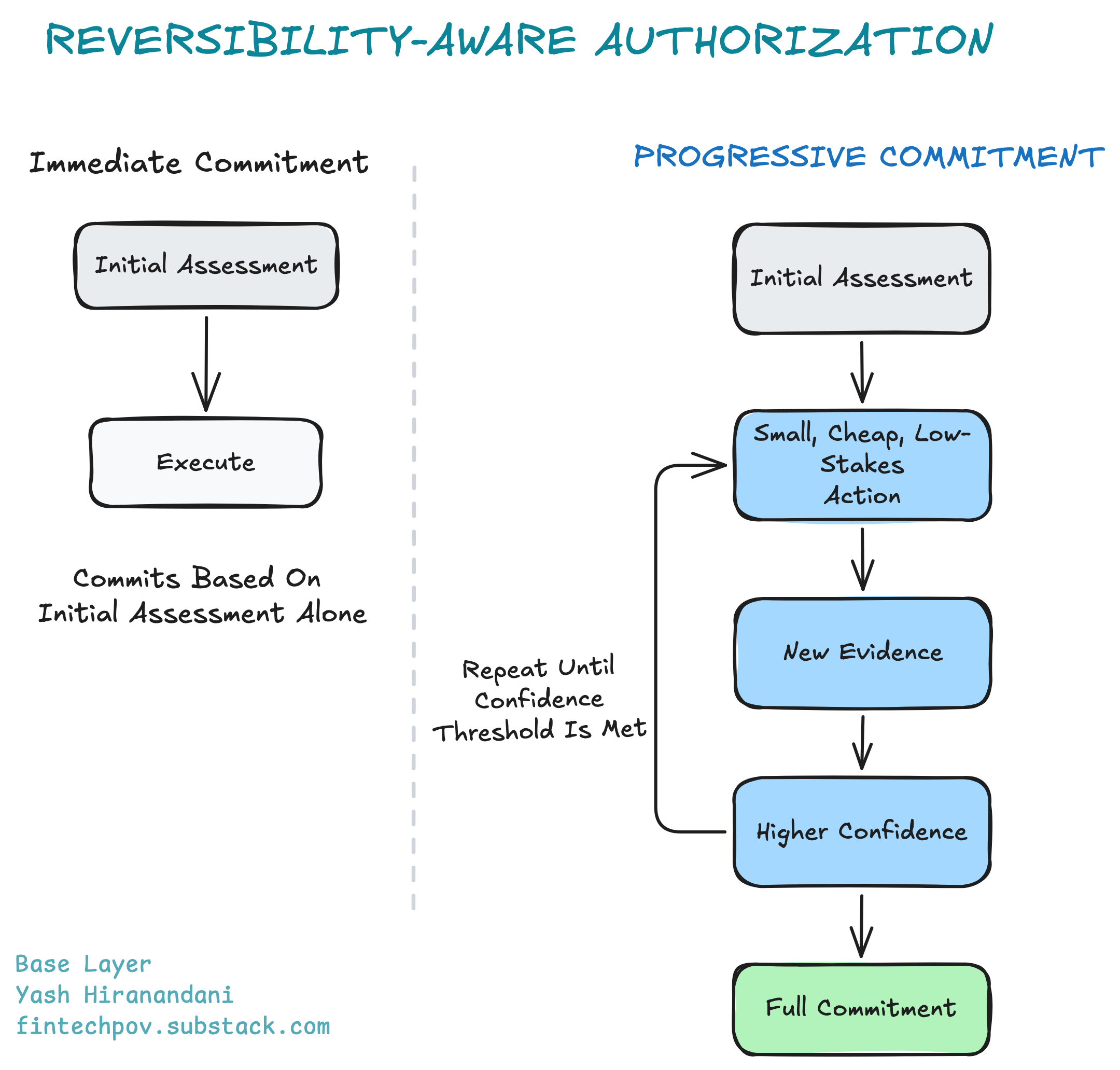
Progressive Commitment: Operationalizing Caution
If you can’t undo an action, don’t commit to it all at once.
Progressive Commitment means taking a smaller, cheaper, more reversible, or lower-stakes step first, then generating new evidence from that step and using it to update confidence. The cycle repeats until confidence exceeds a predefined risk threshold, at which point the agent advances to a higher level of commitment.
The value comes from information and context gain, not merely smaller size.
A dust-sized test transfer before the full payout. A probe before a large purchase. A temporary hold before releasing funds.
This doesn’t improve the model’s raw reasoning. It changes what the model gets to reason over. Each low-stakes step produces fresh information that wasn’t available before. Authorization decisions are therefore informed by evidence generated through interaction with the world rather than relying solely on the agent’s initial prediction.
The key shift is from prediction alone to prediction plus evidence. Instead of asking the model to be perfectly right upfront, the system generates new information through low-stakes actions before authorizing greater commitment.
In the payout example, instead of acting solely on the model’s prediction that an address-chain-token triplet is correct, the system first generates additional evidence through a cheaper, more reversible or low-stakes action.
A small test transfer is one example. If acknowledged by the intended recipient through a trusted out-of-band channel, that new evidence can increase confidence enough to justify the next level of commitment.
This pattern isn’t new — careful treasury teams already do versions of it manually.
Progressive Commitment simply encodes that caution into the authorization layer, so authorization decisions are informed by evidence gathered incrementally through cheap, reversible, or low-stakes actions.
Spend a trivial sum to avoid a catastrophic loss.
But what if confidence never clears the bar?
If the evidence fails to raise confidence past the threshold — the test transfer goes unconfirmed, the probe comes back wrong — the agent doesn’t advance.
It abstains.
That’s the other half of acting safely on irreversible rails: not just committing carefully, but knowing when not to commit at all.
I explored that idea in an earlier piece on Principled Abstention.
What Counts as Reversible?
Reversibility isn’t binary. It depends on how likely recovery is, how long it takes, and how much cost or effort it requires.
Card payments can be charged back (slowly, not guaranteed). Wires can sometimes be recalled (difficult in practice). On-chain settlements, once confirmed, are typically final.
The goal isn’t perfect classification. It’s recognizing that “we can probably recover” and “we probably cannot” are fundamentally different risk categories — and should be authorized differently.
A practical spectrum can look roughly like this:
Highly reversible: Card chargebacks, some ACH returns (days to months, but possible)
Medium: Bank wires (recall possible but difficult), certain escrow setups
Low / Irreversible: Most on-chain settlements once final, instant rails with no clawback
The less recoverable the action, the higher the bar for further commitment.
Failure 2: Death by a Thousand Micropayments
The first failure was one catastrophic transaction. The second is the opposite — many tiny ones — and it shows the same pattern holds on newer rails.
An agent pays other agents (or agent-accessible services) for data, compute, or answers over emerging pay-per-use rails (e.g., HTTP 402-style challenges).
It finds a service, gets back a 402 challenge with a price, signs a USDC micro-payment, and gets served. Each payment is tiny. The loop is fast and autonomous.
The failure isn’t one wrong transaction. It’s the pattern — and it lives in the payments that succeed.
Sometimes the agent can catch a bad result on its own: pay for a number, get back “purple,” the reasoning rejects it. But agents pay external services precisely for things they can’t produce or verify themselves — a real-time price, a fact they don’t independently know, a result they have no ground truth for. A stale price looks identical to a fresh one. The payment clears, the result looks plausible, and the agent has no basis to reject it.
Multiply that across an autonomous loop and the bleed is structural: successful, irreversible payments for results that look fine and aren’t, no single transaction ever looking wrong enough to trip a limit.
This isn’t a widespread problem today — agent-to-agent payment volume is still tiny — but it is exactly the kind of failure the model invites as these systems scale.
How existing guardrails evaluated it:
Per-transaction cap — Pass. Each micropayment is under the limit. The cap is per-action; the harm is cumulative.
Capability guards — Pass. The agent is allowed to make 402 payments. Not whether it should pay this specific endpoint.
Allowlists — Pass. In an open agent economy, services are discovered on the fly. Often there may be nothing to check against.
Evaluation layer — No flag. The payment is well-formed; the judgment that this endpoint was relevant is what’s wrong.
The micropayment model’s greatest strengths — frictionless, autonomous, tiny — are precisely what strip away every natural circuit-breaker.
Progressive Commitment applies directly here too. Because commitment compounds with every successive micropayment, the discipline is to validate before continuing the loop: confirm that the previous payment actually delivered useful results before issuing the next one.
Gate on cumulative spend and observed delivery quality, not just per-transaction caps. An endpoint that keeps getting paid without delivering gets cut off automatically. Earn confidence from real outcomes, not merely settlement — because a payment that clears for a useless result is still a failure.
In short: “Keep paying for results it never checks” becomes “Validate each result before paying again, and increase commitment only as confidence is earned.”
“We already budget for fraud. We’ll budget for this.”
This is the first objection a finance leader usually raises, and it deserves a real answer — because it’s half right.
Businesses absorb losses all the time: fraud, write-offs, operational errors, and disputed transactions.
They price expected loss into the cost of doing business rather than demanding zero-defect systems. So why should agentic loss be any different? Set a tolerance, budget for it, and let the agents run.
Here’s the half that’s missing.
Budgeting works best when losses are distributed across many independent events that average out to a reasonably predictable rate. Fraud, chargebacks, and operational errors are often manageable because no single incident determines the outcome.
The challenge with agentic systems is correlation.
A misjudging agent may not fail just once — it can repeat the same mistake at scale, rapidly, before anyone notices.
It might pay the wrong endpoint a thousand times. It could resolve one incorrect address and propagate that error across every subsequent payout.
The risk is not necessarily a higher overall error rate.
The risk is that a single root error can propagate across thousands of actions in a short time.
And there’s a deeper point: deciding how much loss to tolerate is an authorization decision. “We’ll accept $X in agentic losses” and “We’ll let agents auto-execute irreversible actions once confidence exceeds threshold Y” are the same policy, expressed in different languages.
The CFO who says “just budget for it” hasn’t escaped the design question. They’ve simply stated it in accounting terms.
So yes — budget for agentic loss.
Reversibility-Aware Authorization is how you keep that loss inside the budget. High-blast-radius irreversible actions should clear a higher bar, while cheap, reversible or low-stakes actions could run more freely.
It’s not an argument against accepting loss.
It’s the mechanism that helps keep loss bounded when mistakes can scale faster than humans can react.
What Both Failures Have in Common
Two different rails, one underlying shape: The failure is policy-conformant but semantically wrong — exactly the class of error that existing guardrails are not designed to catch. On an irreversible rail, that uncaught semantic error has no rollback.
One reliable defense is to stop committing the irreversible step until confidence has been earned through cheap, reversible or low-stakes actions.
Progressive Commitment doesn’t make the agent less fallible. It makes its fallibility survivable.
Where This Framework Won't Save You
Three honest limits, because the pattern isn’t magic.
1. It depends on correctly classifying what’s reversible.
Mislabel an irreversible action as reversible, and the protection evaporates. Drawing that line — the reversibility spectrum from earlier — is the hard, unsolved part.
2. The probe is only as good as your ability to design it.
Progressive Commitment assumes the cheap test faithfully predicts the expensive action — and designing a test that actually does is the hard, situational part.
A probe that passes while the real action would fail produces false confidence, which is worse than no probe at all.
It can't be solved once and reused; it has to be built per action type and kept current as the context and the threat landscape change.
3. The thresholds are product and risk decisions, not math.
Where you set the bar trades safety against throughput, and nothing about the pattern resolves that trade for you. It just gives you a place to make it on purpose, instead of by default.
Next, I plan to explore the practical implications of Reversibility-Aware Authorization in more depth— from how systems decide that enough evidence has been gathered, to building a prototype that tests the pattern in code.
Subscribe / follow along as this theory meets reality.
Payments, AI, and financial infrastructure through the lens of first principles and second-order effects. This is Base Layer.
Base Layer | LinkedIn | GitHub | X